Native macOS recording studio

Record it once.
Say it well. Cut it properly.

CamScribe records your screen and your camera on four independent tracks, holds your talking points in front of you while you speak, and hands the take to a real multi-track editor. Your recordings never leave your Mac.

macOS 15 or later, Apple Silicon. In development, not yet released.

  • Record
  • Prompt
  • Edit
  • Caption
  • Export
  • Automate
The CamScribe studio
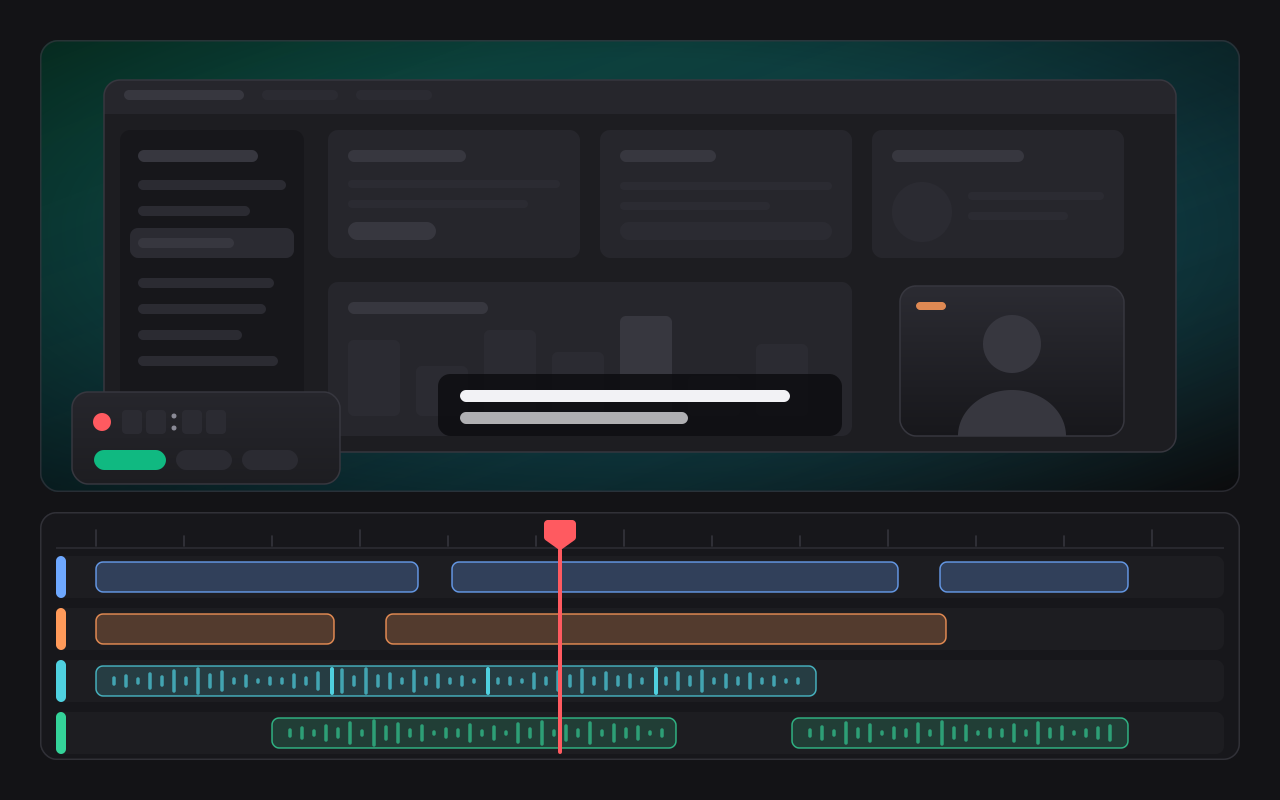
The CamScribe window: a composed canvas showing a screen recording with the presenter's camera beside it, a floating recorder panel, and a multi-track timeline underneath.
4independent tracks

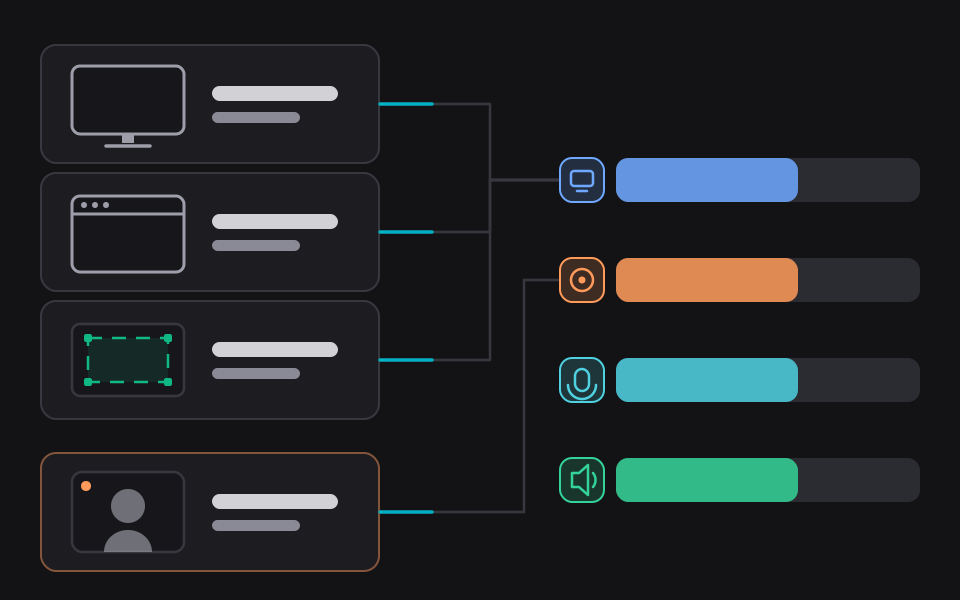
Screen, camera, microphone, system audio

Each one is written by its own writer to its own file. Lose a track and the recording says which one and why, in a sentence, and still hands back everything it did capture.

90 kHzinteger timebase

No floating point in a timeline position

Positions and lengths are integers. Clip speed is an exact reduced fraction, never a decimal. That is what stops audio and video drifting apart as a recording gets longer.

1render pipeline

The preview is the export

Preview and export are the same code, held to it by a test that renders both and compares them. An effect cannot exist in one and not the other, and neither can the trial mark: without Pro you see it in the editor, in the corner the file will carry it.

0accounts, trackers, uploads

Your media never leaves the Mac

Capture, transcription, models, search and export all run on your machine, with the Wi-Fi off if you like. There is no account and no analytics. The one thing that needs a connection is buying, which is the App Store talking to Apple.

Record

Four tracks, written separately, so one failure is not the whole take

Screen, camera, microphone and system audio each get their own writer and their own file. If a device disappears mid take, you get a sentence saying which track was lost and why, and everything else is still there.

Global shortcuts work while CamScribe is in the background, and they use a mechanism that needs no Accessibility grant, so the application never asks for one.

  • Sources. A whole display, a single window, or a region you draw. Built-in, USB and Continuity cameras, with the format and frame rate negotiated rather than assumed.
  • Audio. Microphone and system audio, and system audio can be scoped to particular applications so the notification sound is not in your tutorial.
  • Recoverable. Media is written in chunks that rotate every five minutes, with an index checkpointed every two seconds, so a crash leaves recovery a pointer at the incomplete tail rather than a folder to guess at.
  • Out of shot. The recorder panel, the prompter and the region marker are kept out of the picture two separate ways. Whether the application’s own ordinary windows are recorded is a switch, off by default.
Sources and modes
Capture sources: a whole display, a single window and a drawn region, with a camera source beside them and four independent tracks written underneath.
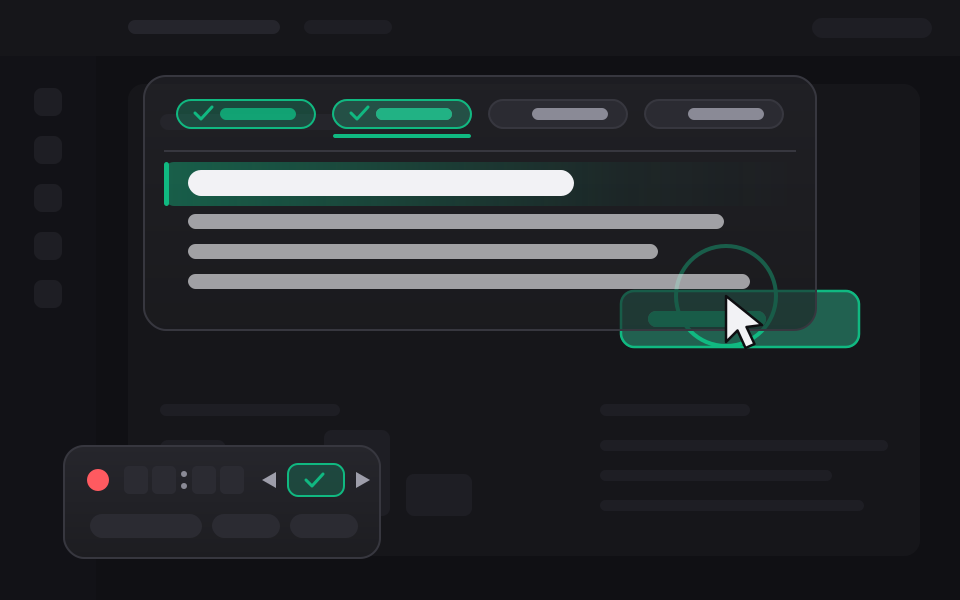
The prompter
A prompter window floating over a screen being recorded, showing a script in reading type with the current line highlighted, and a checklist of talking points beside it.
Prompt

Your talking points, in front of you, not in the recording

Write what you mean to say before you start, and read it while you record. The prompter is a second window with one job, and every control for it also lives on the recorder panel and on a global shortcut.

It works in all three recording modes, and like the recorder panel it is excluded from capture, so it is on your screen and not in your file.

  • One list, two shapes. A headline on its own is a checklist row. A headline with a script under it is a teleprompter beat. You do not choose a feature before you have written a sentence.
  • It never takes the mouse. Clicks pass straight through the prompter to whatever is underneath it, and it fades when your pointer crosses it rather than dodging out of the way.
  • It declines to cover the stop button. If it cannot find room without sitting on the recorder panel, it does not appear.
  • The list belongs to one recording. Points clear when you set up the next take, because a prompter showing the wrong script is worse than no prompter. Your pace, your type size and your saved libraries carry over.
Camera

It finds your face, and tells you what the frame is doing

A camera recording goes wrong in two ways: you leave the frame, and you find out later. CamScribe watches the preview while you record and gives you a guide, then lets you fix the centring properly in the editor once the take exists.

The face guide, the self view and the region marker are all preview surfaces. None of them reaches the file.

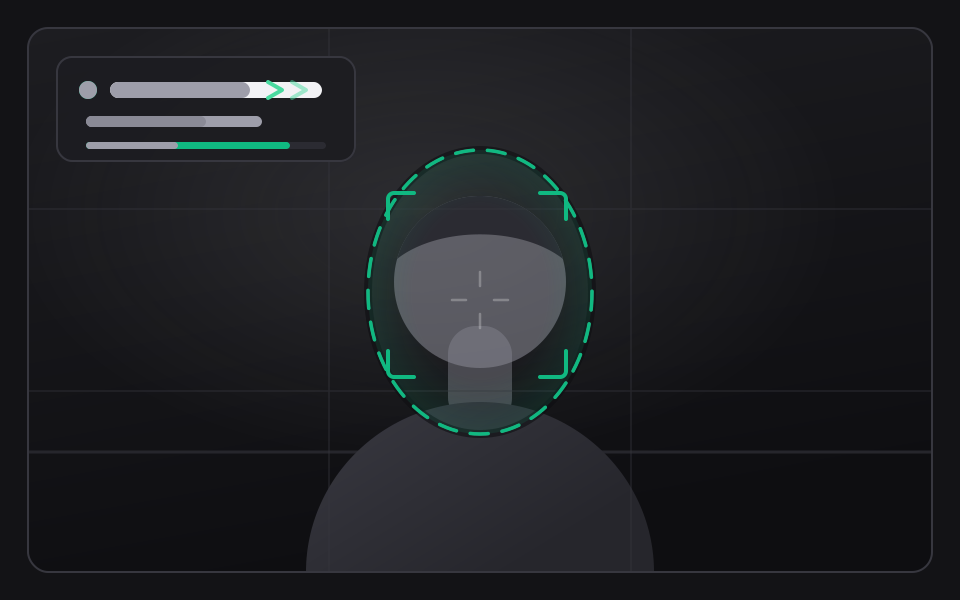
  • While you record. Face detection runs on the live preview and drives a framing guide, so you can see that you have drifted out of shot before you have recorded twenty minutes out of shot.
  • After you record. Analyse the camera track and CamScribe samples frames across the take, finds the largest face in each, and sets the camera plate’s centre from the result. One command, and one undo.
  • Coaching, not correction. Lighting and framing notes are suggestions on a panel, and nothing moves your picture without you asking. The models behind them were trained on generated data rather than on real captures, so each has a plain rule behind it and none of it is load bearing.
  • Studio background. Replace the background behind you, with light wrap and despill, composited in linear light so the edge does not fringe.
Face detection and centring
A camera preview with a detection box locking onto the presenter's face and the frame settling so the face sits on the centre of the plate.
Edit

A real multi-track timeline, not a trim handle

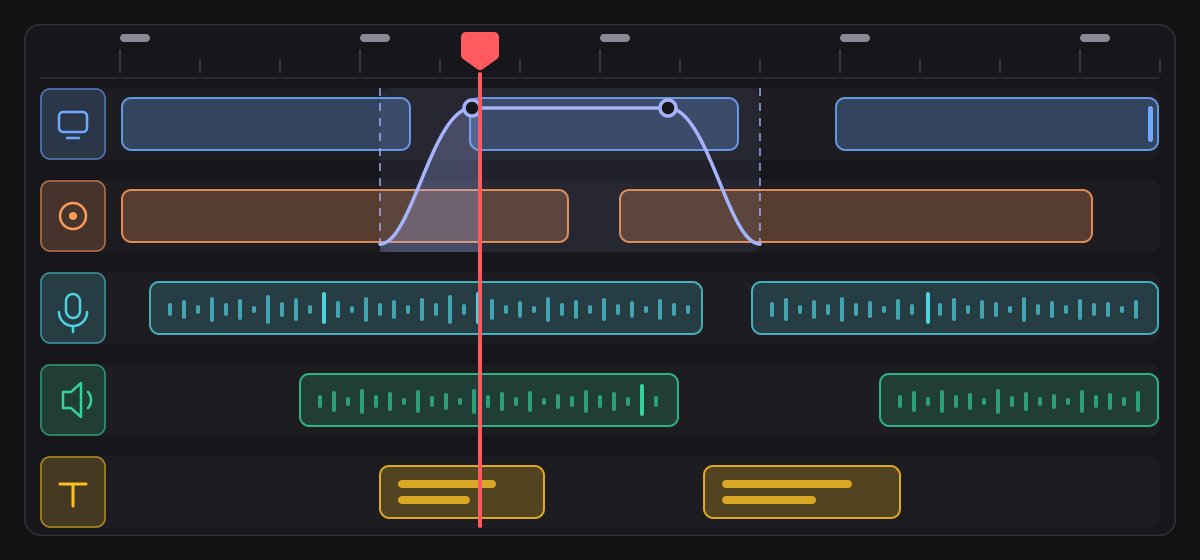
Trim, split, join, remove a range, insert a gap, place a clip anywhere, retime it with an exact fraction, fade it, and set its gain and opacity. Zoom, blur, highlight, mask and volume are all the same automation primitive, so learning one teaches you the rest.

Every edit is a reversible command in a replayable log. Drag a slider eighty times and it is one press of Command Z, because a gesture coalesces. Simple and Advanced modes are curated control by control, and hiding a control never resets it: a project configured in Advanced renders identically in Simple.

The multi-track timeline
A multi-track timeline with separate screen, camera, microphone and system audio lanes, sparse clips at absolute positions, a zoom automation span and a playhead sweeping across.
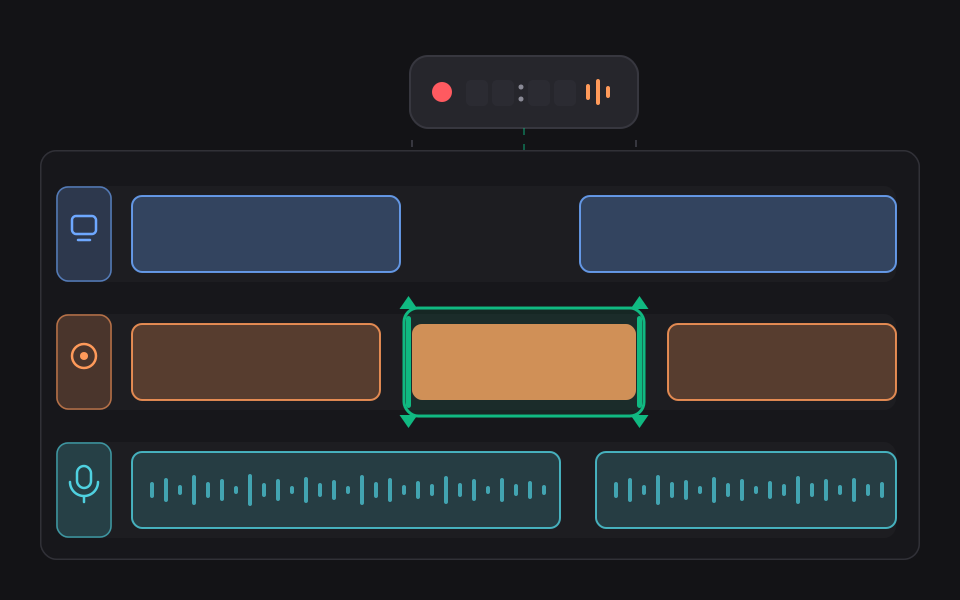
Segment retake
A selected region on one timeline lane being re-recorded and spliced back in place, with the neighbouring clips and the other lanes left untouched.
Retake

Fluff one sentence, re-record one sentence

The usual answer to a stumble is to record the whole thing again. CamScribe lets you select the part that went wrong, record just that, and put it back in place with the rest of the take untouched.

  • Per track. Retake the screen or the system audio for a selected region and splice it back where it was.
  • Three ways to fit it. Overwrite keeps the region exactly as long as it was. Ripple shifts everything after it. Fit changes the speed to make the new material fill the old space.
  • Same encoder, same rules. A retake goes through the recording writer, so the codec ladder, the even dimension guard and the empty file audit all still apply.
  • Fit refuses on audio. Speeding up speech without pitch correction sounds wrong, so that combination is declined rather than shipped badly.
Captions and cards

Captions that survive any player

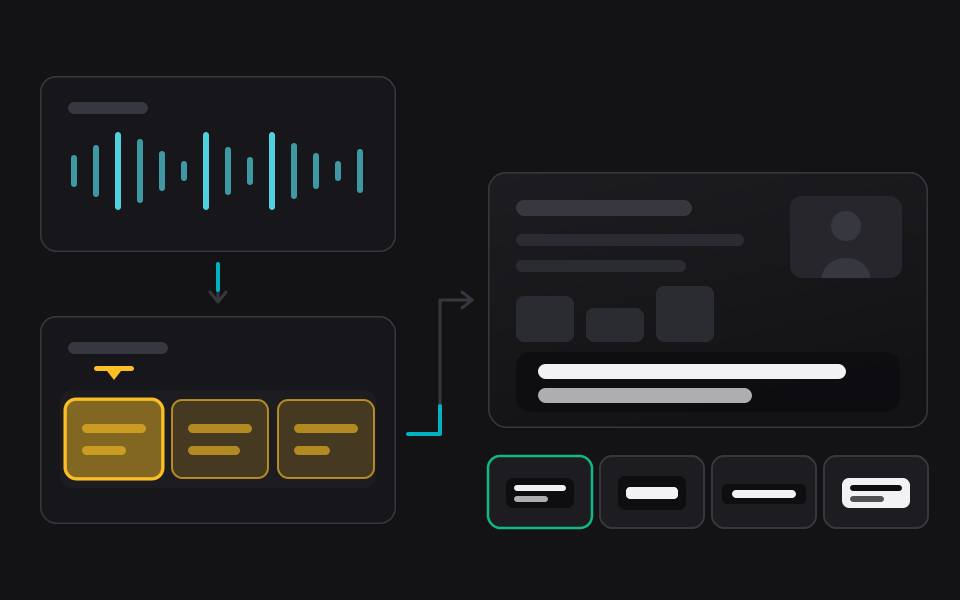
A recording with captions gets watched on mute. CamScribe transcribes on the device, gives you the cues as an editable layer, and burns them into the exported picture.

Title and intro cards are spliced between slices rather than laid over them: inserting one splits every lane at the playhead and moves what follows later by exactly the card's own length, as one action and one undo. Fifty one templates ship, carrying 257 named motion variants, and every length in them is a fraction of the canvas, so a card adapts to 16:9, 9:16, 1:1 and 4:5 by construction.

  • Transcribed on the device. Speech recognition runs locally using the system’s own models. Your audio is not uploaded to be transcribed.
  • An editable layer. Cues land on their own lane. Change the words, move a cue, split one at the playhead, merge two, or write one by hand. Each is one transaction and one undo.
  • Drawn into the picture. Captions are composited into the frame, so they play everywhere. A subtitle file is an extra you can export, not the product.
  • They move out of your face. The caption band lifts to clear a camera plate that crosses the middle of the canvas, which is what stops a vertical video captioning your own forehead.
Captions burned into the picture
Speech transcribed on the device into cues on a captions lane, and the same cue drawn into the exported frame as a caption band.
Model Context Protocol

An agent can drive the whole application

CamScribe ships an MCP server. An agent can list your recordings, configure a take, start and stop it, read the timeline, apply editing commands, queue an export and watch it finish. 45 tools, over five scopes you grant one at a time.

It reaches the same command log the editor reaches. There is no second code path for automation, which is why an agent's edit is undoable in the same window, in the same order, with the same keystroke.

45
tools
5
scopes
56
editor commands
loopback
only
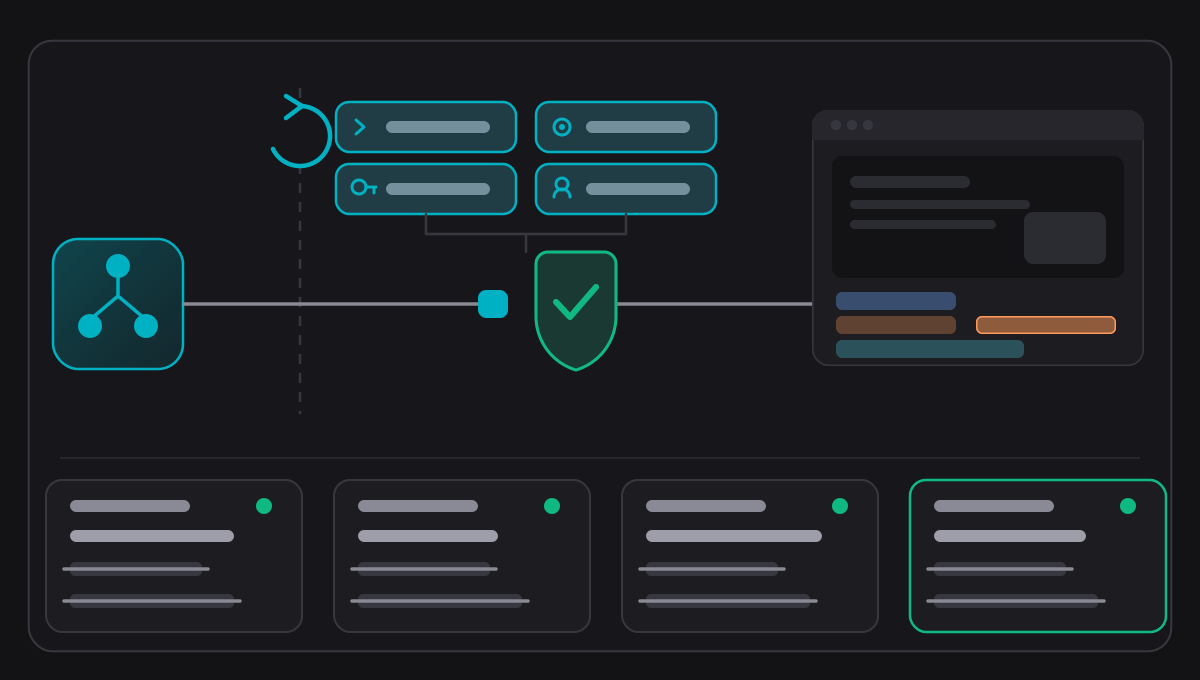
How the authorization works
An agent driving the application
An agent connected to CamScribe over authenticated loopback, calling a tool, being checked against its granted scopes and the application's state, and the call being written to the audit log as metadata.
  • Both transports are loopback only. There is no remote access, no TLS and no pairing, deliberately.
  • Every request is authorized in the engine from the action, the application state, your granted scopes and whether you are actually at the Mac.
  • Pause and stop are the only actions allowed while you are away, because stopping a recording should always be possible.
  • The audit log records metadata. Not your arguments, not your prompts, not your file paths, not the token.
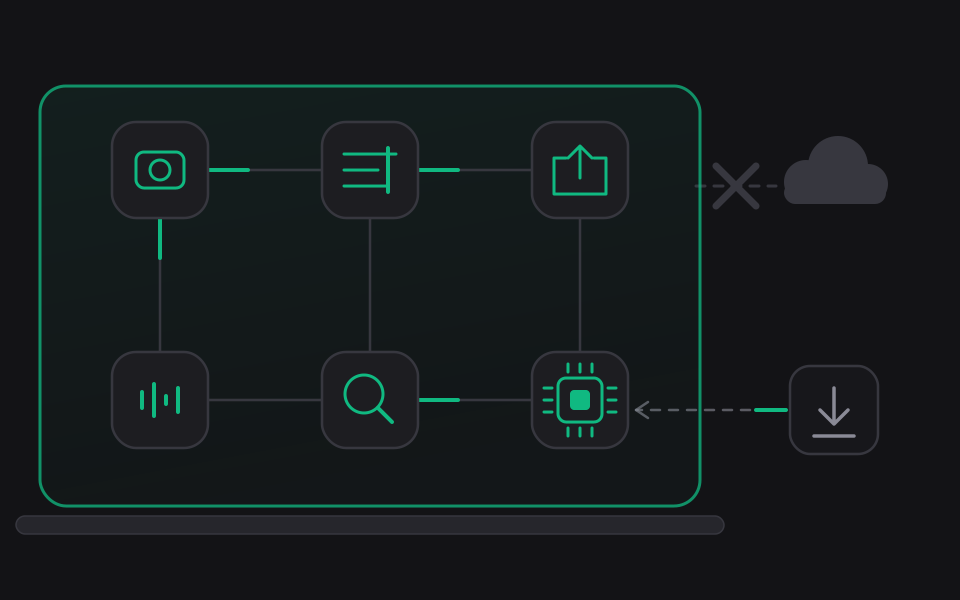
Everything stays on the Mac
A Mac drawn as a closed boundary with capture, transcription, models, search and export inside it, and the route off the machine crossed out.
On device

Your work never goes anywhere

Recordings are yours and they stay where you made them. Capture, transcription, models, search and export all run on the Mac, and every one of them works with the network switched off. No recording, no frame and no transcript is ever uploaded, because there is nothing in the application that could upload one.

Search across your recordings builds its index inside the recording's own package, and a redactor strips email addresses, phone numbers, card numbers, addresses and personal names from the transcript before anything is indexed.

  • No account. There is nothing to sign up for and nothing to sign in to. Pro is attached to the Apple Account you buy it with, which Apple holds and we never see.
  • No HTTP client of its own. The application contains no URLSession and opens no outgoing socket. Its own networking is a loopback listener for the MCP server, which never leaves the machine.
  • Buying is the exception. The App Store needs a connection to show you a price, take a purchase and restore one. That request is made by Apple’s own framework, on the app’s behalf, and it reaches Apple rather than us. Nothing else in the application asks for the network.
  • One download, and it is not yours. Asking for captions in a language your Mac does not have yet makes macOS fetch Apple’s speech model, the same act as adding a keyboard language. You start it, it carries no audio, and your recording still does not move.
  • No analytics. No telemetry, no crash reporter, no third party SDK, no identifiers.
  • No model saw your media. Every shipped model was trained on generated data, and no customer recording was used to train anything. None has been validated against a real capture either, which is why each one has a deterministic rule behind it and CamScribe records, edits and exports correctly with no models installed at all.
What it costs

Free to record and edit. Pro is about the export

No trial clock, no project count and nothing greyed out. An export made without Pro carries a small mark and is capped at 1080p, and the editor shows you that mark rather than saving it for afterwards.

Pro Monthly

$2.99per month

Renews every 1 month

Pro Yearly

$24.99per year

Renews every 1 year

Pro, one-off

$99.99once

Never renews

All three unlock the same thing: an export with no mark, at the size you asked for. Two of them are auto-renewable subscriptions and renew until you cancel them in your Apple Account; the third is paid once and never renews. CamScribe is not released yet, so there is nothing to buy today. What is free, and what Pro costs.

Early access

CamScribe is in development. Come and break it.

It is built, it is tested, and it has never met your hardware. If you record on a Mac and you would rather tell us what is wrong than wait for it to be finished, ask Olib AI for a build.